Relational Model was proposed by E.F. Codd to model data in the form of relations or tables. After designing the conceptual model of Database using the ER diagram, we need to convert the conceptual model in the relational model which can be implemented using any RDBMS languages like Oracle SQL, MySQL, etc. So we will see what the Relational Model is.
What is Relational Model?
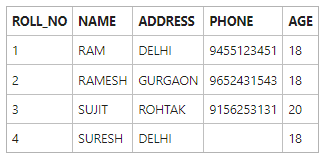
Relational Model represents how data is stored in Relational Databases. A relational database stores data in the form of relations (tables). Consider a relation STUDENT with attributes ROLL_NO, NAME, ADDRESS, PHONE and AGE shown in Table 1.
STUDENT
IMPORTANT TERMINOLOGIES

Relation Instance: The set of tuples of a relation at a particular instance of time is called as relation instance. Table 1 shows the relation instance of STUDENT at a particular time. It can change whenever there is insertion, deletion or updation in the database.
Degree: The number of attributes in the relation is known as degree of the relation. The STUDENT relation defined above has degree 5.
Cardinality: The number of tuples in a relation is known as cardinality. The STUDENT relation defined above has cardinality 4.
Column: Column represents the set of values for a particular attribute. The column ROLL_NO is extracted from relation STUDENT.
| Roll No |
|---|
| 1 |
| 2 |
| 3 |
| 4 |
NULL Values: The value which is not known or unavailable is called NULL value. It is represented by blank space. e.g.; PHONE of STUDENT having ROLL_NO 4 is NULL.
Constraints in Relational Model
While designing Relational Model, we define some conditions which must hold for data present in database are called Constraints. These constraints are checked before performing any operation (insertion, deletion and updation) in database. If there is a violation in any of constrains, operation will fail.
Domain Constraints: These are attribute level constraints. An attribute can only take values which lie inside the domain range. e.g; If a constrains AGE>0 is applied on STUDENT relation, inserting a negative value of AGE will result in failure.
Key Integrity: Every relation in the database should have at least one set of attributes that defines a tuple uniquely. Those set of attributes is called key. e.g.; ROLL_NO in STUDENT is a key. No two students can have the same roll number. So a key has two properties: